
When Did Fashion Get So… Safe?
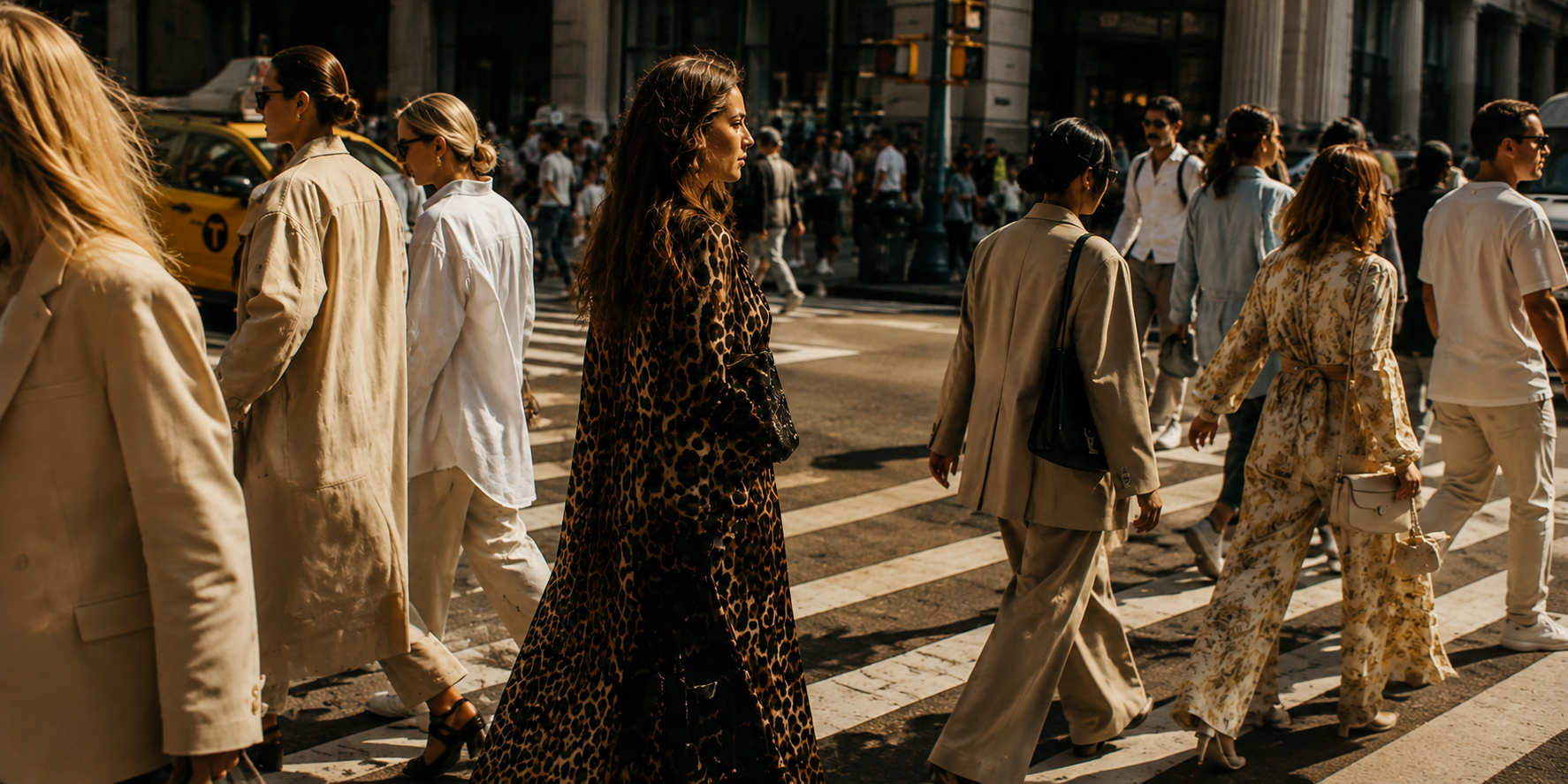
After years of quiet luxury, clean girls and perfectly curated neutrals, fashion seems ready to have a personality again.
I have always been fascinated by big cities.
Not just for the obvious reasons — the restaurants, the fashion, the endless list of places to be — but because of the people who live in them. There is something about a big city that makes you pay attention. What people wear. What they carry. Where they go. What they order. The tiny choices that, without saying much at all, somehow tell you something about who they are.
I have always been a people watcher.
Put me at a restaurant terrace for twenty minutes and, somewhere between ordering a drink and pretending not to stare, I will have mentally catalogued the shoes, bags and outfits of everyone around me.
This year has taken me from Madrid, the city I call home, to London, Tokyo and Miami. Four very different cities, with very different ideas of what looks good, what feels current and what is worth paying attention to.
Naturally, I watched.
And somewhere between them, I started noticing something.
After years of perfectly curated neutrals, quiet luxury and clean girl everything, people seemed to be having a little more fun with their clothes again.
Colour. Prints. Charms. Scarves. Leopard. Stripes. Things that didn't necessarily match — and somehow looked better because of it.
And I couldn't help but wonder:
Are we finally getting bored of beige?
How calm became aspirational?
The years following the pandemic were characterised by an unusual amount of uncertainty and overstimulation.
Our visual world became loud.
And somewhere along the way, calm became aspirational.
You could see it everywhere.
In interiors: warm woods, natural materials, cream sofas and carefully restrained spaces.
In beauty: slicked-back hair, barely-there makeup and the rise of the clean girl.
In fashion: neutral palettes, elevated basics, understated silhouettes and eventually the explosion of quiet luxury.
Brands such as The Row built entire universes around restraint. SKIMS transformed shades of beige, brown, black and white into an instantly recognisable visual language. Alo Yoga helped turn wellness into an aesthetic: polished, controlled and seemingly effortless.
The absence of visual noise became a form of luxury.
Less became more.
And then, perhaps, less became everywhere.
When an aesthetic becomes a uniform
There is an interesting contradiction at the heart of consumer behaviour.
We use products to belong, but we also use them to differentiate ourselves.
Fashion is particularly good at exposing this tension.
Quiet luxury originally felt distinctive precisely because it rejected many mainstream status signals. But as the aesthetic travelled from luxury fashion to social media and eventually into the mass market, its codes became incredibly easy to replicate.
TikTok taught us how to dress old money. Pinterest taught us how to build the perfect neutral wardrobe. Retailers translated the same visual language at every price point.
And this raises an interesting question:
What happens when an aesthetic built around taste and individuality becomes a formula?
It loses some of its ability to differentiate.
The return of visual stimulation
After my latest trip to Miami, I started noticing the same signals elsewhere.
More colour. Scarves tied around bags and waists. Polka dots. Stripes. Animal prints. Florals. Jewellery that wants to be noticed. Vintage pieces. Bag charms. Unexpected colour combinations.
Even the runways are becoming less afraid of being noticed. Spring/Summer 2026 brought tomato red, lime, violet and emerald back into the conversation, while prints, florals and pattern clashes are increasingly appearing across collections and street style.
Something is shifting.
Not necessarily from minimalism to maximalism.
But from curation to expression.
From the aesthetic economy to the personality economy
For much of the last decade, the internet has been exceptionally good at giving us identities to adopt: clean girl, old money, Scandi girl, vanilla girl, mob wife.
Millions of people expressing their individuality through essentially the same Pinterest board.
Algorithms are incredibly effective at teaching us what good taste is supposed to look like.
And perhaps consumers are beginning to feel the limitations of that.
Because personal style was never supposed to be perfectly optimised.
Personal style contains contradictions because people contain contradictions.
And that may explain why imperfection is starting to feel interesting again.
Fashion may only be the beginning
This is where the shift becomes particularly interesting from a consumer perspective.
Because what if this emerging desire for personality extends beyond our wardrobes?
Walk through the premium FMCG aisle of almost any supermarket today and you will recognise a familiar language.
Muted colours. Matte finishes. Serif typography. Minimal illustrations. Natural textures. Generous amounts of negative space.
Minimalism became an incredibly effective shortcut for communicating premium, natural, modern and considered.
If forty products on a shelf are whispering, suddenly the brand willing to speak may be the one we notice.
We may therefore begin seeing FMCG brands rediscover some of the things fashion is rediscovering now: distinctive colour combinations, illustration, heritage codes, typography with character, humour, texture and visual worlds that are difficult to confuse with competitors.
So, is minimalism dying?
I don't think so.
The white T-shirt is not disappearing. Neither is the black trouser, the beautifully designed neutral home or our appreciation for simplicity.
Minimalism solved something important for consumers: it gave us functionality, versatility and relief from visual excess. Those needs have not disappeared.
But perhaps uniformity is beginning to lose its appeal.
What comes next may not be a return to head-to-toe maximalism, but something more nuanced:
a minimalist foundation with an expressive layer.
Consumers may still want simplicity.
They just don't necessarily want sameness.
And perhaps that is what caught my attention while sipping coffee around all these cities .
Not the return of colour itself, but the return of something colour represented.
The desire to be recognisable again.
